
Does Muscle Soreness Mean Muscle Growth?
Muscle soreness after training is commonly interpreted as a sign that a workout was effective and that muscle growth is occurring. This assumption is widespread but not well supported by evidence. Soreness and muscle growth are related to some of the same processes, but they do not reliably track each other. Understanding why requires a closer look at what each of these responses actually involves.
What Is Happening Physiologically
When muscles are exposed to unfamiliar or high-load exercise, particularly movements that involve lengthening under tension, small-scale disruption occurs within the muscle fibres. This disruption triggers an inflammatory response, which involves the release of signalling molecules, increased blood flow to the area, and a degree of localised swelling.
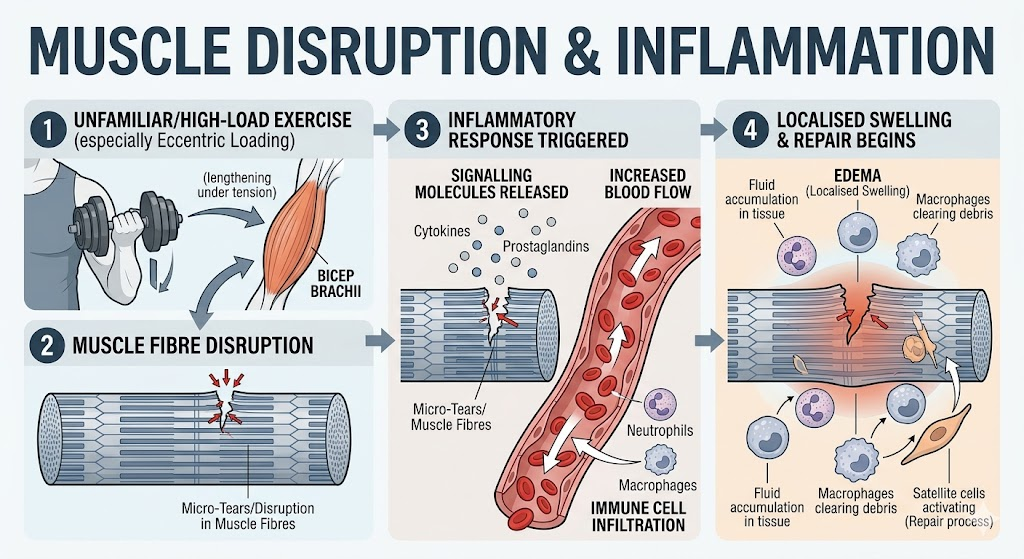
This inflammatory process is associated with the sensation of delayed onset muscle soreness, typically referred to as delayed onset muscle soreness (DOMS). The soreness itself is thought to arise from sensitised nerve endings in and around the muscle, rather than from ongoing damage. The sensation peaks roughly 24 to 72 hours after exercise and tends to resolve within a few days.
Muscle growth, or hypertrophy, involves a separate but partially overlapping set of processes. Mechanical tension applied to muscle fibres activates signalling pathways that promote protein synthesis. Over time, repeated exposure to this stimulus leads to an increase in the size of muscle fibres. Research indicates that mechanical tension, muscle damage, and metabolic stress can each play a role in this process, though they do not contribute equally or consistently across individuals.
Why the Confusion Exists
Both soreness and muscle growth can follow the same type of training session. Eccentric loading, high training volumes, and unfamiliar exercises tend to produce soreness. These same variables are also associated with hypertrophic stimulus. The correlation between them has led many people to treat soreness as a proxy for growth.
This interpretation is understandable but problematic. Just because two outcomes follow the same input does not mean one causes or predicts the other. Soreness is largely driven by the novelty and mechanical disruption of a session. Growth is driven by sustained mechanical tension and progressive overload over time. These are distinct processes with different time courses and different determining factors.
For more detail on what causes muscle soreness after exercise, including the role of eccentric contractions and microtrauma, that is covered separately.
Common Misconceptions
Soreness means the workout worked
This is the most common version of the misunderstanding. Soreness indicates that the session introduced a sufficient novelty or load to cause some degree of localised disruption. It does not confirm that the session was well-structured, appropriate for the individual, or effective at stimulating growth. A session can produce significant soreness while providing little hypertrophic stimulus, and vice versa.
No soreness means no progress
As muscles adapt to a given type of training, the soreness response diminishes. This is known as the repeated bout effect. A person who trains consistently will often experience little or no soreness from sessions that are nonetheless sufficient to maintain or increase muscle mass. A 2023 systematic review and meta-analysis examining muscle damage markers across repeated exercise bouts found that the protective adaptation is consistent and measurable, reinforcing that reduced soreness over time reflects adaptation rather than reduced training effectiveness. The absence of soreness in trained individuals is not a reliable signal that training load or effectiveness has dropped.
More soreness means more growth
There is no established dose-response relationship between the degree of soreness and the extent of muscle growth. Extreme soreness, sometimes caused by very high volumes of unfamiliar training, may actually impair recovery and reduce training quality in subsequent sessions. This is not a productive outcome. There is no meaningful basis for treating greater soreness as evidence of greater stimulus.
What the Evidence Suggests
Research on hypertrophy has consistently found that mechanical tension is the primary driver of muscle growth. This is generated by lifting loads that challenge the muscle across its range of motion, particularly at long muscle lengths. Inflammation and muscle damage may contribute to the growth response in some contexts, but they are not necessary conditions for hypertrophy to occur.
Studies examining the relationship between soreness and hypertrophy have generally not found a meaningful correlation. Individuals can achieve substantial muscle growth over weeks and months of training while experiencing minimal post-exercise soreness. Conversely, training programmes that produce consistent soreness do not necessarily produce superior hypertrophic outcomes.
A peer-reviewed paper by Brad Schoenfeld examined whether exercise-induced muscle damage plays a role in skeletal muscle hypertrophy. It reviewed the available evidence and concluded that while some researchers have hypothesised that the inflammation and protein turnover associated with muscle damage are necessary for hypertrophic adaptation, others have demonstrated that hypertrophy can occur in the relative absence of muscle damage. The evidence does not support damage or soreness as a reliable requirement for growth.
It is worth noting that the evidence base on hypertrophy mechanisms is still developing. Individual responses to training vary, and some degree of disruption may contribute to the growth response in certain populations or training contexts. However, the claim that soreness directly indicates growth is not well supported.
How long soreness lasts and what influences its duration is covered in the article on how long DOMS lasts.
Practical Implications
Soreness is a signal, not a target. It indicates that the body encountered a sufficient level of novel or demanding stress. Beyond that, it does not carry reliable information about whether training is working in the way most people assume.
For training decisions, more useful signals include performance over time, adherence to progressive overload, sleep quality, and overall recovery. If strength or work capacity is increasing across weeks of training, that is a more reliable indication that the programme is effective than whether any given session produced soreness.
It is also worth considering that chasing soreness as a goal can lead to unproductive training patterns. Constantly introducing novel exercises or excessive volume to provoke soreness may interfere with the consistency and specificity that support long-term progress.
The sensation of stiffness that often accompanies soreness is a separate phenomenon. It involves neural protective responses and localised swelling rather than ongoing damage. This is covered in more detail in the article on why muscles feel stiff after training.
Managing training load appropriately is likely more relevant to both recovery and long-term progress than using soreness as a guide. The training load and fatigue hub covers this in more depth, and the recovery methods hub addresses what actually supports the recovery process.
Summary
Muscle soreness and muscle growth share some underlying biology but do not reliably predict each other. Soreness reflects localised disruption and the inflammatory response that follows. Muscle growth is driven primarily by mechanical tension and progressive overload. The two can occur together, but one is not a consistent indicator of the other.
Using soreness as a measure of training effectiveness is likely to produce misleading conclusions. Evidence suggests that mechanical load, consistency, and recovery are more meaningful variables for long-term hypertrophy. Soreness is worth understanding, but it is not a useful target.For a broader overview of what happens in the muscle soreness and recovery space, the muscle soreness hub provides structured navigation across all related topics.