
How Long Does DOMS Last?
Delayed onset muscle soreness (DOMS) usually lasts between three and five days. It typically develops within 12 to 24 hours after exercise and reaches peak intensity somewhere between 24 and 72 hours. However, this timeline is not fixed. It varies meaningfully depending on the individual, the type of exercise performed, and how accustomed the body is to that kind of physical stress. This is explored further across the broader muscle soreness hub.
What Is Happening Physiologically
When muscle tissue is exposed to unfamiliar or high levels of mechanical stress, particularly during exercises that involve lengthening under load, small amounts of structural disruption occur within the muscle fibres. This is sometimes called microtrauma, though the exact mechanisms are still a subject of ongoing research.
In the hours that follow, the body initiates a repair and inflammatory response. Immune cells move into the affected tissue. Fluid accumulates. Nerve endings in and around the muscle become more sensitive to pressure and movement. It is this combination of inflammation, swelling, and increased nerve sensitivity that produces the sensations associated with DOMS, including tenderness, stiffness, and reduced range of motion.
The soreness does not appear immediately after exercise. This delay is why the condition is described as “delayed onset”. The inflammatory process takes time to develop, which is why the feeling often worsens over the first day or two before gradually easing.
As the repair process progresses, inflammation reduces, structural integrity is restored, and nerve sensitivity returns to baseline. This sequence of disruption, inflammation, and repair is what creates the delayed onset and multi-day duration of DOMS.
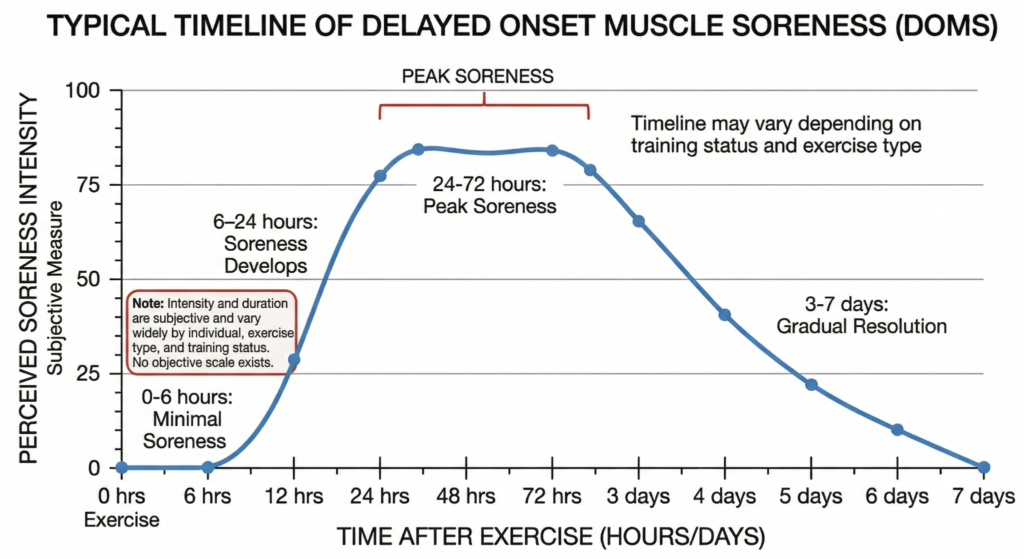
Why DOMS lasts for several days
The 24 to 72 hour peak and three to five day resolution are general patterns based on research averages. Individual variation can be significant.
Several factors influence how long DOMS lasts:
Training status
People who train regularly in a given movement pattern tend to experience shorter and milder DOMS. This is related to what researchers refer to as the repeated bout effect: after initial exposure to a stimulus, the body adapts in ways that reduce the damage and inflammatory response in subsequent sessions. Someone returning to exercise after a long break, or attempting a genuinely new type of training, is likely to experience more pronounced and longer-lasting soreness.
Exercise type
Exercises that emphasise the lengthening phase of muscle contraction, known as eccentric contractions, consistently produce greater DOMS than concentric or isometric work. Running downhill, lowering a weight slowly, or performing exercises like Romanian deadlifts and Nordic curls place significant eccentric load on the muscle and tend to result in more pronounced soreness. The greater the eccentric demand, the more likely soreness is to persist toward the longer end of the typical range. Understanding what causes muscle soreness helps explain why eccentric loading has this effect.
Exercise volume and intensity
A single high-volume or high-intensity session, particularly one that departs significantly from what the body is accustomed to, tends to produce more prolonged soreness than a moderate session. Evidence suggests that the relationship between training load and DOMS duration is not perfectly linear, but more demanding sessions do generally produce more persistent soreness.
Individual biology
People vary in how their bodies mount and resolve inflammatory responses. Age, sex, fitness level, nutritional status, and sleep quality may all contribute to differences in DOMS severity and duration. The research in this area is not fully settled, and the relative contribution of each factor is difficult to isolate in practice.
Common Misconceptions
DOMS lasting longer means more muscle was built
There is no clear evidence that a longer or more severe bout of DOMS corresponds to greater muscle growth. Soreness reflects a degree of disruption and the body’s response to it. It is not a reliable signal of hypertrophic adaptation. People who experience very little DOMS after training can still make consistent progress.
DOMS should be gone within 48 hours
While many people recover within this window, soreness extending to four or five days after a particularly demanding or novel session is not unusual. Duration alone is not a sign that something is wrong.
Feeling no soreness after exercise means the session was ineffective
As the body adapts to a training stimulus, DOMS becomes less pronounced or disappears entirely, even when training volume and intensity remain constant. This reflects adaptation, not reduced effectiveness.
Lactic acid causes DOMS
This is a persistent but inaccurate explanation. Lactic acid clears from the muscle within an hour of exercise and does not contribute to the soreness that develops in the following days. The mechanisms behind DOMS are related to structural disruption and the subsequent inflammatory response, not lactate accumulation.
What the Evidence Suggests
Research on DOMS duration broadly supports a peak between 24 and 72 hours and a return to baseline within five to seven days in most cases. Studies involving novel eccentric exercise protocols, such as downhill running or resistance training in untrained populations, frequently report peak soreness at 48 hours.
Evidence for the repeated bout effect is fairly consistent. A second bout of the same exercise, performed days or weeks after the first, tends to produce substantially less soreness and a faster recovery timeline. This adaptation appears to persist for several weeks, sometimes longer.
The mechanisms underlying this adaptation are not fully understood. Proposals include changes in the mechanical properties of muscle tissue, modifications in the inflammatory response, and adaptations in the nervous system. Current understanding suggests it is likely a combination of factors rather than a single explanation.
There is limited evidence that any widely available intervention meaningfully shortens DOMS duration. Cold water immersion and massage show modest effects on perceived soreness in some studies, but the magnitude of benefit is generally small and findings are mixed. These are discussed in more detail in the Recovery Methods section.
Practical Implications
For most people, DOMS is a temporary and self-resolving response. Understanding the typical timeline can help set realistic expectations and reduce unnecessary concern when soreness persists for several days.
A few points are worth noting:
DOMS that peaks within 24 to 48 hours and gradually resolves over the following days is within the normal range. Soreness that is still worsening beyond 72 hours, or that does not begin to resolve after five to seven days, may warrant attention, particularly if it is accompanied by significant swelling or a marked loss of function.
For those planning training around soreness, evidence suggests that light movement during the recovery period is unlikely to prolong DOMS and may modestly reduce the perception of soreness. This is not the same as training through pain or ignoring significant soreness.
For those returning to exercise after a break, or introducing a new movement pattern, some degree of DOMS is expected. Moderating the initial volume and intensity of new training reduces the severity and duration of soreness without preventing adaptation. Gradual progression remains the most reliable way to manage DOMS across training cycles.
There is no intervention that eliminates DOMS entirely or reliably shortens its duration in a clinically meaningful way. Sleep, adequate nutrition, and appropriate training load management remain the primary factors that support recovery over time.