
What Causes Muscle Soreness After Exercise?
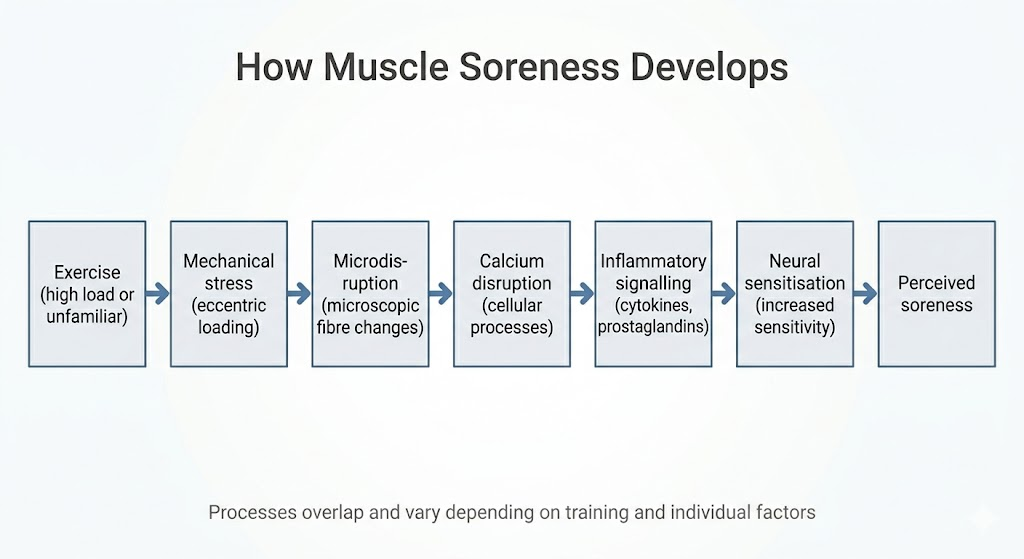
Muscle soreness after exercise is caused by a combination of mechanical stress on muscle fibres, inflammatory signalling, and increased neural sensitivity.
These interacting processes produce the delayed pain and functional changes commonly referred to as delayed onset muscle soreness, or DOMS, which is explained in more detail in What is DOMS?
What is happening physiologically
Eccentric contractions and mechanical strain
Eccentric contractions occur when a muscle lengthens under load, such as lowering a weight or running downhill. These actions generate high mechanical tension within muscle fibres and can produce uneven stretching of sarcomeres, the basic contractile units of muscle.
When strain exceeds local tolerance, microscopic structural disruption can occur. This includes changes to sarcomeres, Z lines, and cytoskeletal proteins. These changes are often described as microdisruption and do not represent large-scale tearing.
Calcium disruption and secondary processes
Structural disruption can affect calcium regulation within muscle cells. Elevated intracellular calcium may activate proteolytic enzymes and other secondary processes that develop over several hours.
These delayed processes contribute to temporary cellular dysfunction and help explain why soreness does not appear immediately after exercise. This delayed pattern also explains the typical timeline of DOMS, including when it peaks and resolves.
Inflammatory signalling and neural sensitisation
Mechanical stress triggers a local inflammatory response. Immune cells migrate to the affected tissue and release signalling molecules such as cytokines and prostaglandins.
These mediators alter the local environment and increase sensitivity of nociceptors, which are sensory nerve endings responsible for detecting discomfort. This process, known as neural sensitisation, increases pain perception without requiring large scale structural damage.
The combined effect of structural changes, chemical signalling, and neural sensitivity can reduce strength, limit range of motion, and increase passive stiffness until recovery occurs. For a broader overview of how soreness fits into the wider topic, see the muscle soreness hub.
Why it happens
Volume and intensity
Training volume refers to the total amount of work performed, while intensity reflects the load relative to capacity. Large increases in volume or high intensity eccentric loading increase mechanical stress within a session and raise the likelihood of soreness.
Exercise novelty
Introducing new exercises or returning after a period of reduced training can expose muscle tissue to unfamiliar stress patterns. This can concentrate strain on less adapted structures and increase the likelihood of soreness.
Range of motion
Using a greater range of motion can increase the length at which muscle fibres are loaded. This may increase mechanical strain and contribute to soreness, particularly when combined with eccentric loading.
Repeated bout effect
The repeated bout effect describes how prior exposure to a movement reduces soreness in subsequent sessions. Adaptations may include improved motor coordination, structural reinforcement, and altered inflammatory responses.
This effect can occur after a single exposure and may persist for weeks, reducing soreness without preventing adaptation.
Several training variables influence the likelihood and severity of muscle soreness. These factors determine how much mechanical stress is placed on muscle tissue and how the body responds to it.
| Factor | What it means | How it contributes to soreness |
| Volume | Total work performed (sets and reps) | Higher volume increases total mechanical stress across muscle fibres |
| Intensity | Load relative to capacity | Heavier loads increase tension within individual fibres, especially during eccentric phases |
| Exercise novelty | New or unfamiliar movements | Unaccustomed stress patterns increase local strain and likelihood of soreness |
| Range of motion | Degree of muscle lengthening under load | Greater stretch positions can increase mechanical strain on fibres |
| Training status | Level of adaptation to a movement | Less adapted individuals typically experience greater soreness |
| Repeated bout effect | Adaptation after initial exposure | Reduces soreness in subsequent sessions of the same movement |
Common misconceptions
Lactic acid causes soreness
This is incorrect. Blood lactate levels typically return to baseline within about one hour after exercise, whereas DOMS develops many hours later. The timing and underlying mechanisms do not support lactate as the cause.
Soreness equals muscle growth
Soreness is not a reliable indicator of hypertrophy. Muscle growth is influenced by mechanical tension, training volume, proximity to failure, and recovery capacity. It is possible to achieve progress with minimal soreness.
DOMS is the same as acute injury
DOMS usually reflects transient microdisruption and neural sensitisation. Immediate sharp pain, significant swelling, bruising, or persistent weakness are more consistent with muscle strain or injury and may require clinical assessment.
What the evidence suggests
Evidence suggests that eccentric exercise produces greater soreness than concentric exercise, and that untrained individuals typically experience larger responses than trained individuals. The repeated bout effect is consistently observed across studies.
However, interpretation requires caution. Many experimental studies use exaggerated eccentric protocols that may not reflect typical training conditions. Biomarkers such as creatine kinase do not consistently correlate with perceived soreness, and individual variability is high.
Based on available evidence, muscle soreness should be understood as a multifactorial response influenced by both mechanical and neural factors. Findings are mixed in some areas, and responses depend on exercise type, intensity, volume, and individual characteristics.
Practical implications
Muscle soreness is a predictable short term response to mechanical loading rather than a direct measure of training effectiveness. Because soreness can influence movement quality and training frequency, it is useful to interpret it alongside other indicators such as performance, readiness, and overall fatigue.
Understanding how training load accumulates over time helps explain why soreness may vary between sessions, even when exercises appear similar. This broader context is explored further in the training load and fatigue section and in the wider context of recovery methods, which influence how the body responds to and resolves soreness.
Soreness should be considered one part of the overall training response rather than a primary outcome to be maximised.
Short summary
Muscle soreness after exercise arises from mechanical strain on muscle fibres, secondary cellular processes, inflammatory signalling, and neural sensitisation. Training variables such as volume, intensity, novelty, and range of motion influence the response. Evidence suggests these factors interact, responses vary between individuals, and no single mechanism fully explains soreness.