
What Is DOMS?
Delayed onset muscle soreness (DOMS) is a transient increase in muscle pain and stiffness following unfamiliar or high-load exercise, associated with microscopic structural disruption and increased pain sensitivity.
DOMS follows a delayed and variable time course. Soreness typically develops within 6 to 24 hours, peaks within 24 to 72 hours, and resolves over several days depending on training and individual factors, including how recovery is managed through methods such as sleep, nutrition, and other recovery methods.
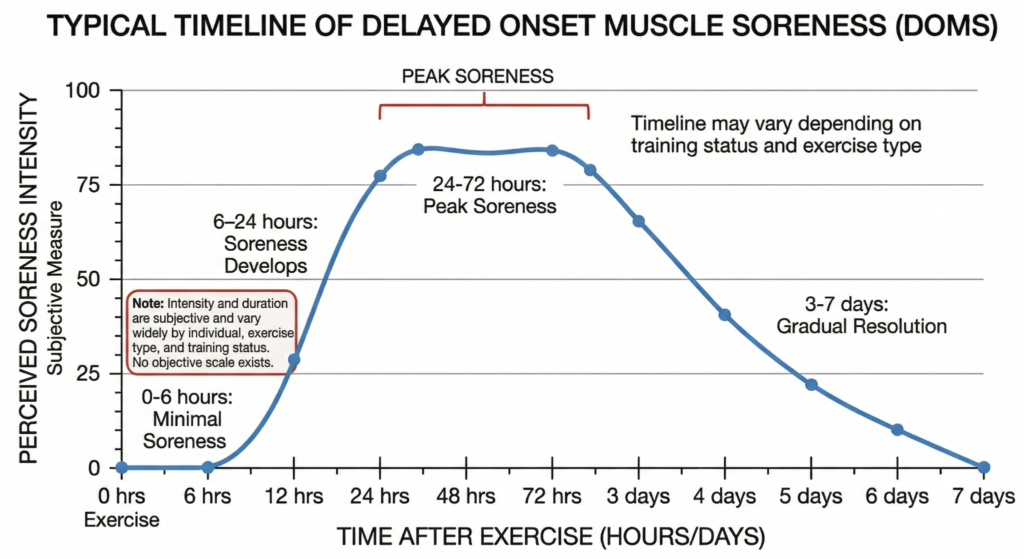
DOMS reflects a temporary response to mechanical stress driven by training load rather than a major structural injury, and should be understood alongside broader concepts such as training load and fatigue.
What is happening physiologically
Eccentric contractions, where muscle fibres lengthen under load, impose high mechanical strain on skeletal muscle. That strain can damage microscopic structures including sarcomeres, Z lines and cytoskeletal proteins. When strain exceeds a fibre’s tolerance, local microdisruption occurs.
Structural disruption can disturb calcium regulation within muscle cells. Elevated intracellular calcium may activate proteolytic enzymes and other secondary processes that progress over hours. These delayed cellular cascades help explain why soreness often peaks well after the training session.
A local inflammatory response follows micro-disruption. Increased blood flow, immune cell migration and release of cytokines and prostaglandins sensitize nociceptors and increase pain perception. The combination of structural changes and neural sensitisation produces measurable functional effects, including reduced maximal strength, decreased rate of force development, reduced range of motion and increased passive stiffness. These impairments are generally transient and resolve as tissue repair and adaptation occur.
These underlying mechanisms are explained in more detail in what causes muscle soreness after exercise.
Why it happens
Mechanical overload is the primary trigger for DOMS. Eccentric actions generate high tension with comparatively low metabolic cost, so movements such as lowering a weight, descending into a squat or running downhill create conditions that favour microdisruption. Novelty of loading also matters. Introducing a new exercise, increasing range of motion, markedly raising volume or returning after a prolonged break increases the likelihood of DOMS.
The repeated bout effect reduces soreness after initial exposure. Possible adaptive mechanisms include improved motor unit recruitment patterns, strengthening of connective tissue and structural reinforcement at the sarcomere level. These adaptations can occur after a single exposure and may persist for weeks, reducing soreness in subsequent sessions.
Common misconceptions
Lactic acid causes DOMS. This is not the case. Blood lactate typically returns to baseline within about one hour after exercise, while DOMS develops many hours later. The temporal mismatch and mechanistic evidence do not support a causal role for lactate.
More soreness means more muscle growth. Evidence does not consistently support this. Hypertrophy is influenced by mechanical tension, training volume, proximity to failure and recovery capacity. It is possible to achieve muscle growth with little soreness, particularly in trained individuals. Soreness severity does not reliably predict long term adaptation.
DOMS is the same as a muscle strain. DOMS usually reflects transient microdisruption and neural sensitisation. Immediate, sharp, highly localised pain, marked swelling, bruising or persistent weakness are more consistent with a muscle strain or other injury and warrant clinical assessment. Severe systemic symptoms, such as dark urine or extreme weakness, may indicate rare but serious conditions such as rhabdomyolysis and require urgent medical evaluation.
What the evidence suggests, including limitations
Evidence suggests eccentric exercise produces greater DOMS than concentric exercise and that untrained individuals typically experience larger responses than trained individuals. The repeated bout effect is documented across multiple studies, and strength loss often precedes peak soreness, indicating functional impairment can occur before maximum pain.
However, limitations affect how findings should be interpreted. Many studies use exaggerated eccentric protocols that may not reflect common training practices. Biomarkers such as creatine kinase do not consistently correlate with subjective soreness. Individual response variability is high, and results depend on exercise type, intensity, volume and participant characteristics. Where studies disagree, it is appropriate to state that findings are mixed or that evidence suggests a particular effect rather than stating certainty.
Practical implications, presented without early advice
Recognise DOMS as a predictable short term response to novel or high mechanical loading rather than an outcome to be maximised. Because DOMS can reduce movement quality and training frequency, unmanaged soreness may increase injury risk if load is not adjusted. Gradual progression of volume and intensity and including familiarisation sessions can exploit the repeated bout effect while limiting excessive soreness.
When planning training, treat soreness as one indicator among several, including objective performance metrics, readiness measures, sleep quality and nutrition, rather than relying on soreness alone to judge adaptation. Distinguish DOMS from acute injury by considering onset timing and symptom pattern. Immediate sharp pain, substantial swelling or persistent functional loss should prompt clinical evaluation.
Internal references
For further detail on mechanisms and related topics see the Muscle Soreness hub.
Summary
DOMS is delayed muscle pain after unaccustomed or high load exercise driven by microscopic structural disruption, disturbed calcium handling and local inflammation.It typically peaks 24 to 72 hours, with the full duration varying depending on training and individual factors. This timeline is explored in more detail in how long DOMS lasts.