
Why Do Muscles Feel Stiff After Training?
Muscles feel stiff after training because of three overlapping processes: fluid accumulation in and around the muscle tissue, increased sensitivity in the nerves that detect muscle stress, and temporary changes in the mechanical properties of the muscle fibres themselves. These responses develop in the hours following exercise and are part of the body’s normal repair process, not a sign of injury.
Stiffness and soreness are related but distinct. Stiffness refers to reduced ease of movement and resistance when trying to move through a full range of motion. Soreness refers to pain sensitivity, the tenderness felt when pressure is applied or the muscle is used. The two often occur together but involve different mechanisms and do not always appear in equal measure. Both are covered in more detail across the muscle soreness hub.
What Is Happening Physiologically
When muscle tissue is stressed during exercise, a sequence of physiological events follows. These events affect not just the muscle fibres themselves, but the surrounding tissue, fluid balance, and the nervous system.
Swelling and fluid accumulation
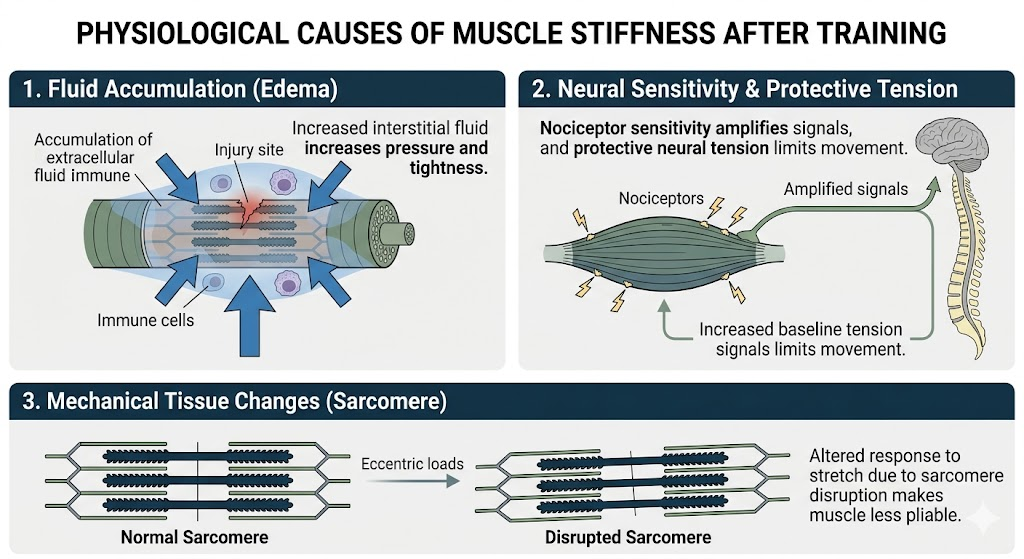
Exercise, particularly unfamiliar or high-load exercise, causes small amounts of structural disruption in muscle fibres. In response, the body initiates an inflammatory process. Fluid and immune cells move into the affected area. This accumulation of fluid increases pressure within the muscle tissue and contributes to a feeling of tightness and resistance when trying to move through a full range of motion.
This swelling is part of the normal repair process. It is not a sign of injury in the clinical sense, but it does temporarily alter how the muscle feels and functions.
Neural sensitivity and protective tension
The nervous system responds to the signals generated by exercise-related muscle stress. Nociceptors, the nerve endings that detect potentially damaging stimuli, become more sensitive in and around the affected muscle tissue. The nervous system may also increase baseline muscle tension as a protective response, limiting movement to reduce further mechanical stress on tissue that is in the process of repair.
This protective increase in muscle tone contributes meaningfully to the sensation of stiffness. It is not purely a structural change in the muscle itself. The muscle is also receiving signals that bias it toward less movement.
Changes in muscle tissue mechanics
Some research suggests that changes in the mechanical properties of muscle fibres following exercise may contribute to stiffness. Disruption at the level of the sarcomere, the small repeating unit inside a muscle fibre that produces contraction, can temporarily alter how the muscle responds to being stretched. The result is a muscle that feels less pliable and more resistant to elongation than usual.
Why Stiffness Happens
Stiffness after training is the combined result of the three processes described above. Each contributes to reduced movement ease in a different way, and they interact. Fluid accumulation increases pressure on nerve endings, which amplifies sensitivity. Increased neural tension further limits movement. Changes in tissue mechanics make the muscle more resistant to stretch. The combined effect is the stiffness that many people notice in the hours and days after a demanding session.
Stiffness tends to be more pronounced after exercises that involve a significant lengthening phase under load, such as lowering a barbell slowly, running downhill, or performing exercises like Romanian deadlifts. This is because these types of contractions, known as eccentric contractions, produce more structural disruption than concentric or isometric work. The role of eccentric loading in post-exercise responses is explained in more detail in what causes muscle soreness after exercise.
Common Misconceptions
Stiffness and soreness are the same thing
They frequently occur together, but they involve different sensations and different underlying mechanisms. Soreness is primarily a sensitivity to pain and pressure. Stiffness is primarily a restriction in ease of movement. Delayed onset muscle soreness describes the pain and tenderness that follows unfamiliar or high-load exercise. It is possible to experience significant stiffness with little soreness, and vice versa. Treating them as interchangeable can lead to misunderstanding of what the body is experiencing after training.
Stiffness means the muscle is damaged and needs rest
Stiffness is a normal physiological response to exercise stress. It does not necessarily indicate damage in the clinical sense, and it does not always require complete rest. Light movement during the recovery period is unlikely to worsen the underlying process and may modestly reduce the perception of stiffness in some individuals.
Stretching will eliminate post-training stiffness
Static stretching before or after training has a limited effect on stiffness that arises from the inflammatory process and neural responses described above. It may provide temporary relief by reducing neural tone, but the available evidence does not support the idea that stretching meaningfully shortens the duration of post-exercise stiffness.
Stiffness indicates the workout was effective
Like soreness, stiffness is not a reliable indicator of training quality or adaptation. It reflects the magnitude of the disruption relative to what the body is accustomed to. As the body adapts to a given type of training, stiffness typically becomes less pronounced, even when training volume and intensity remain the same or increase.
What the Evidence Suggests
The evidence on post-exercise stiffness is less extensive than on soreness more broadly, and the two are often studied together rather than as distinct phenomena.
Research generally suggests a link between eccentric exercise and greater post-exercise stiffness and reduced range of motion compared to concentric exercise. Studies using measures of passive stiffness, which assess how a muscle resists being stretched when not actively contracting, show transient increases following eccentric loading. These changes generally resolve within a similar timeframe to delayed onset muscle soreness.
Evidence for the repeated bout effect applies here too. A second exposure to the same exercise stimulus tends to produce less stiffness and a faster return to baseline. This adaptation appears to involve changes in both the mechanical properties of muscle tissue and the way the nervous system responds to repeated stress.
The role of swelling in stiffness is reasonably well supported. Fluid accumulation increases intramuscular pressure, which contributes to reduced range of motion and the sense of tightness. Interventions that modestly reduce swelling, such as cold water immersion, show some effect on perceived stiffness in certain studies, though effect sizes are generally small and results are mixed. These are discussed in the recovery methods hub.
The neural contribution to stiffness is less well characterised. There is evidence that muscle activation patterns change following eccentric exercise, which may reflect a protective neural response, but the precise mechanisms are not fully established.
Practical Implications
How long does muscle stiffness last?
Post-exercise stiffness typically follows a similar timeline to soreness. It tends to develop within the first 12 to 24 hours, may peak around 24 to 48 hours, and generally resolves within three to five days for most people. This is consistent with the repair timeline described in how long does DOMS last. Individual variation can be significant depending on training history, exercise type, and volume.
Is stiffness a reason to stop training?
Not necessarily. Mild to moderate stiffness is a normal response to training and does not by itself indicate that a session should be skipped. However, significant stiffness that reduces movement quality or affects technique may warrant reduced intensity or adjusted exercise selection on subsequent sessions. How to navigate training decisions around soreness and stiffness is addressed further in the training load and fatigue hub.
What can be done about stiffness?
No intervention reliably removes the underlying processes that cause post-exercise stiffness. Light movement and low-intensity activity may reduce the perception of stiffness temporarily, likely by reducing neural tone and encouraging circulation, but they do not accelerate the repair process itself. Adequate sleep and appropriate nutrition support the conditions under which recovery occurs. Time remains the most consistent factor in resolution.
Stiffness can also be a signal of accumulated fatigue, particularly when it persists beyond the typical three to five day window or appears after sessions that were not especially demanding. In those cases, it may reflect a broader recovery debt rather than an isolated response to a single session. The relationship between fatigue and recovery capacity is explored further in what is muscle fatigue.
For those introducing new exercise or returning after a break, moderating the initial volume and intensity of eccentric-heavy training reduces the severity of post-exercise stiffness without preventing adaptation. Gradual progression is the most evidence-supported approach to managing stiffness as part of a consistent training programme.